
Reading Poetry
A rondeau brings its opening words back as a shorter refrain
A rondeau’s short recurring phrase changes as the surrounding poem develops. Read the return as an event, not just a repeated line.

For the reading life, on and off the shelf.
A rondeau’s short recurring phrase changes as the surrounding poem develops. Read the return as an event, not just a repeated line.

Follow the repeated lines of a pantoum and notice how new neighbours change their meaning. Try a short original exercise before reading the ending again.

A tipped-in illustration is attached differently from a folded section. Learn to notice the join without stressing an old book.

Buckram is a practical bookbinding cloth with several finishes. Learn what it can tell you about a cover and what it cannot prove about the book inside.

A dos-à-dos binding joins two text blocks back to back. Learn how to recognise the structure without confusing it with two works bound in one volume.
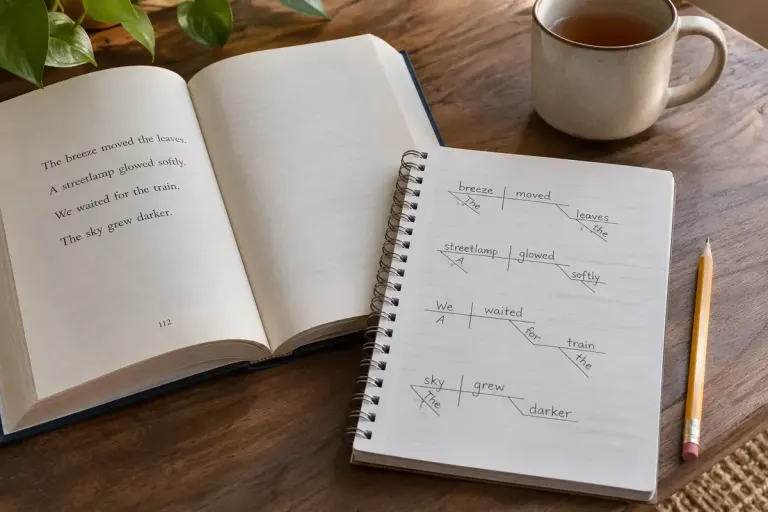
Try two short passages to hear how parataxis and hypotaxis organise clauses, pace a scene and change what a narrator seems to emphasise.

Separate the narrator’s voice from the perspective limiting a scene. A short invented example makes focalisation easier to notice in your next novel.

When a landscape seems to share a character’s feelings, look closely at the narration. Pathetic fallacy can reveal mood, perspective or a deliberate mismatch.

Read a dramatic monologue by listening for the speaker, the silent audience and the details that escape the speaker’s intended story.