
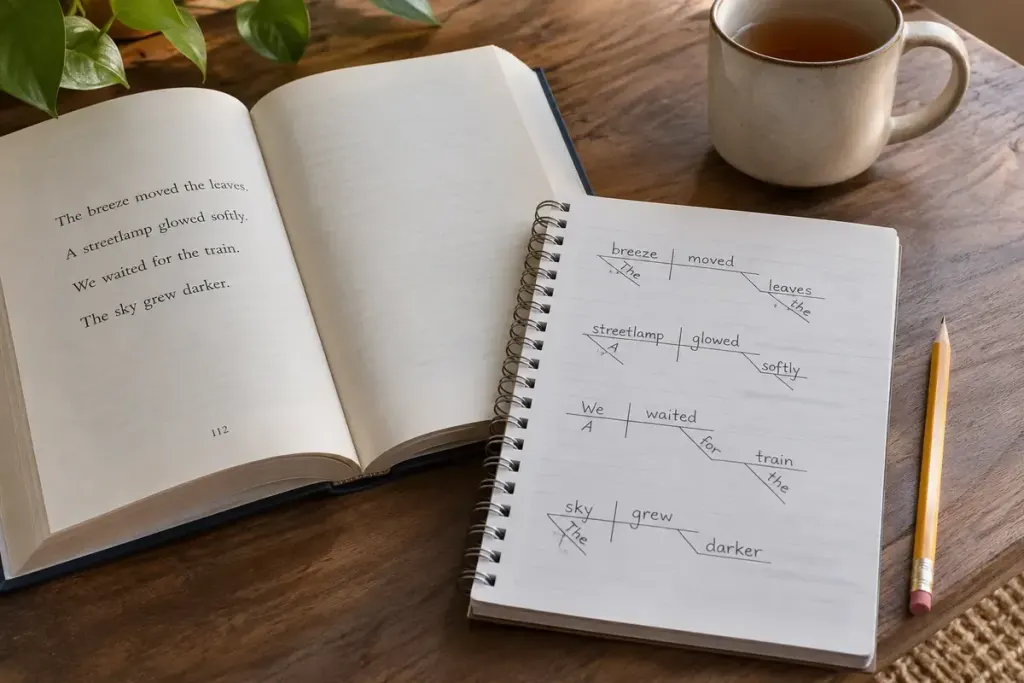
Some sentences place events beside one another and let you connect them. Others explain the relationship before you reach the full stop. The difference can change the atmosphere of a page even when the events stay almost identical.
Two useful terms are parataxis and hypotaxis. Parataxis gives clauses a more equal standing; hypotaxis organises them through subordination. John Burt’s writing notes at Brandeis University discuss these ways of connecting ideas. They are tools for noticing a writer’s decisions, rather than grades for good and bad prose.
Read these invented examples aloud
The train stopped. The lights failed. Mara kept her hand on the door.
When the train stopped and the lights failed, Mara kept her hand on the door.
The first version gives each event its own beat. The reader supplies the connection between the failure and Mara’s response. The second makes the first two events a setting for the main action. Its grammar tells us where to place the weight.
Now change the opening to “Although the train stopped and the lights failed.” The facts have barely moved, but the relation has: Mara’s action sounds persistent or unexpected. A small connecting word can carry a large interpretive instruction.
Listen beyond sentence length
A long sentence can still coordinate a series of equal clauses. A short sentence can contain a subordinate clause. Counting words alone will miss the relationship that matters.
On your next page of fiction, choose one sentence with several actions. Underline the main clause and circle words such as because, although and while. Then try a private rewrite that removes the connections. Ask what becomes uncertain, abrupt or more open to interpretation.
There is no need to prefer the smoother version. A narrator may deliberately refuse to explain why events belong together. Another may guide every connection. Once you hear that choice, the rhythm of the book becomes part of its storytelling rather than background decoration.