
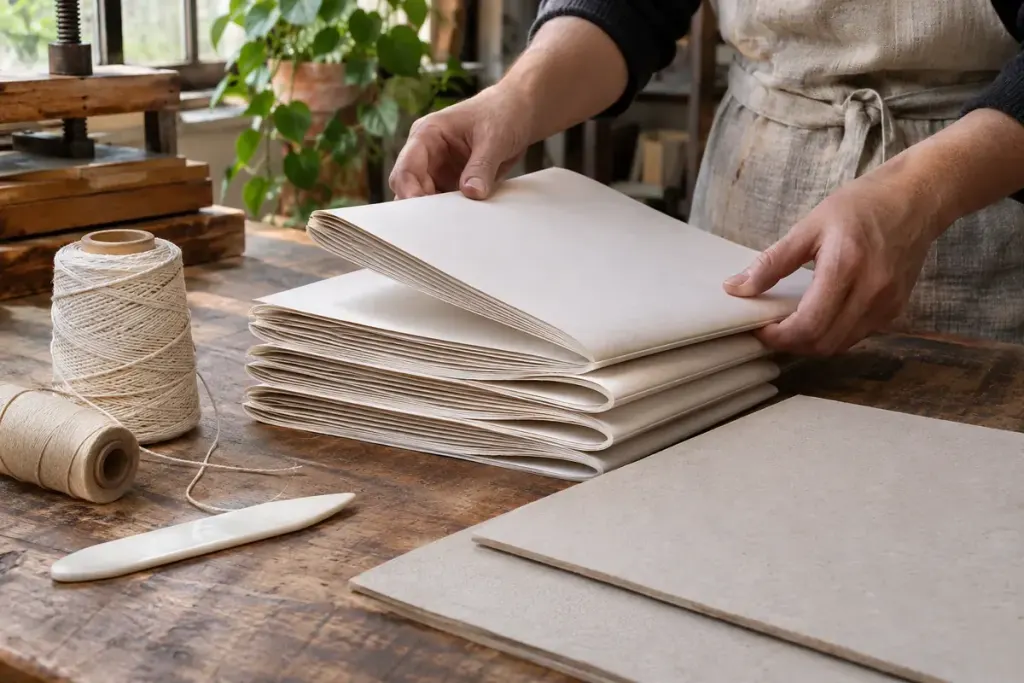
Today, a book’s cover often seems inseparable from its publication. In the hand-press era, the printed sheets and the finished binding could belong to different stages of the buying process. A reader might acquire the text and then arrange for a binder to turn it into the volume they wanted.
The Folger Shakespeare Library’s account of temporary boards bindings describes books sold in loose sheets and bound according to a buyer’s taste and budget. It places inexpensive boards bindings within the transition toward later publisher-produced cases.
One edition, different physical lives
Two copies of the same printed edition can therefore have very different covers. One may have received an elaborate binding, another a simpler one, and another may have been rebound much later. A cover alone cannot settle every question about the date or identity of the text inside.
This creates an interesting way to look at a catalogue entry. Read the publication statement and the binding description separately. Notice whether the catalogue calls the binding contemporary, later, temporary or restored. Those words describe evidence, not just decoration.
A modest cover may preserve valuable information
Folger’s discussion of book form and function explains that temporary bindings and unaltered text blocks can preserve traces of how a book was sold and used. A plain wrapper is not necessarily something a collector should improve.
If you encounter an old volume, photograph its condition without forcing it open and record any known provenance. Ask a qualified conservator before replacing covers, trimming edges or making repairs. An attractive alteration can remove evidence that cannot be put back.
Ask a more precise collecting question
Instead of “Is this the original cover?”, try “What evidence dates this binding, and how does it relate to the printed edition?” The answer may include materials, sewing structure, ownership marks and documented repairs.
For a reading copy, usability may be the priority. For a historical object, the relationship between text, binding and owners may be part of its value. Knowing which question you are asking makes a bookseller’s description much easier to interpret.
The book on the shelf is the result of several decisions. Sometimes the printer supplied the pages and a later reader supplied the shape in which they survived.