
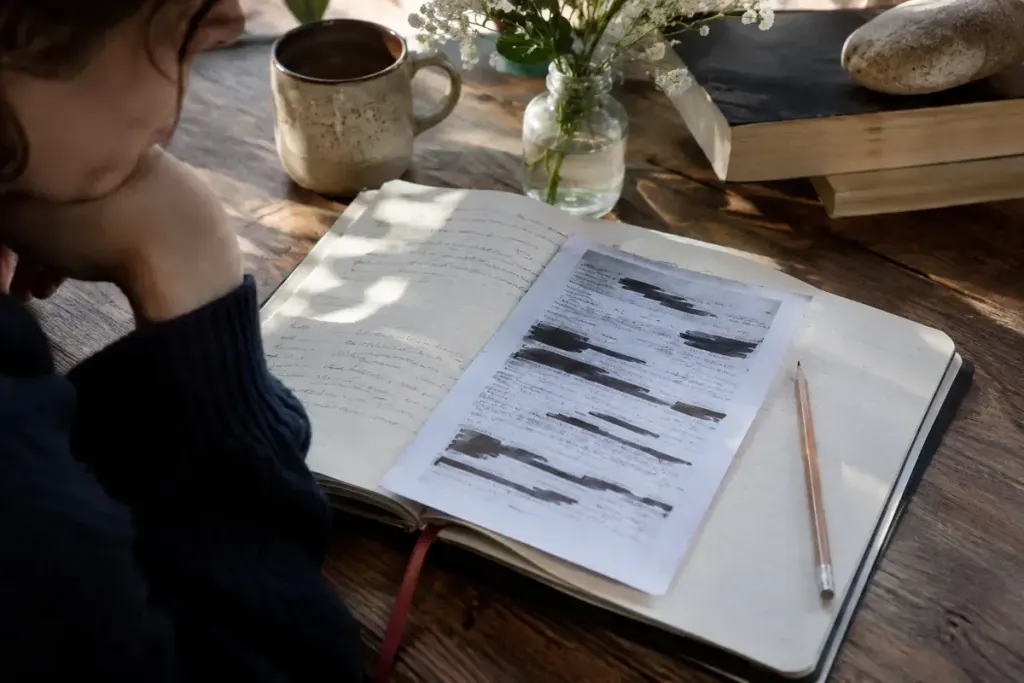
A page can become a poem through subtraction. In erasure poetry, selected words remain while other language is removed, obscured, or left unread. The surviving words matter, but so does the reader’s awareness that something once surrounded them.
The Academy of American Poets’ erasure glossary describes the form and examples of its practice. It belongs to the wider territory of found-text writing, yet the act of removal gives it a distinctive relationship with its source.
Try a small example with your own sentence
Consider this invented line: “At dawn the station windows held a pale light while the last traveller waited.” Keep only “dawn,” “held,” “the,” and “traveller,” in that order, and the result reads: “dawn held the traveller.”
The new phrase changes the agent of the action. Dawn now appears to hold someone, rather than merely providing the time of day. No new word was needed, but the relationship between the retained words changed substantially.
This is a miniature exercise, not a complete rule for the form. Different poets use different visual arrangements and constraints. Some leave visible gaps; others present a more continuous reading surface.
Read the gaps as well as the line
Ask how the page directs your eye. Are you meant to jump across a large absence, follow a narrow column, or notice fragments of the underlying document? Then ask what the source contributes: its subject, authority, rhythm, or historical context may remain active even where its words disappear.
A useful second reading compares the new poem with the original passage. Notice whether the poem resists the source, discovers an unexpected image inside it, or makes a familiar statement less secure. You need not settle on one intention to describe what the choices do.
For your own experiment, use a text you wrote or a suitable public-domain source. Preserve the source details and check rights before sharing a derived work. Work on a copy rather than marking a borrowed book. The pleasure is in attentive selection, not in making the original impossible for another reader to use.