
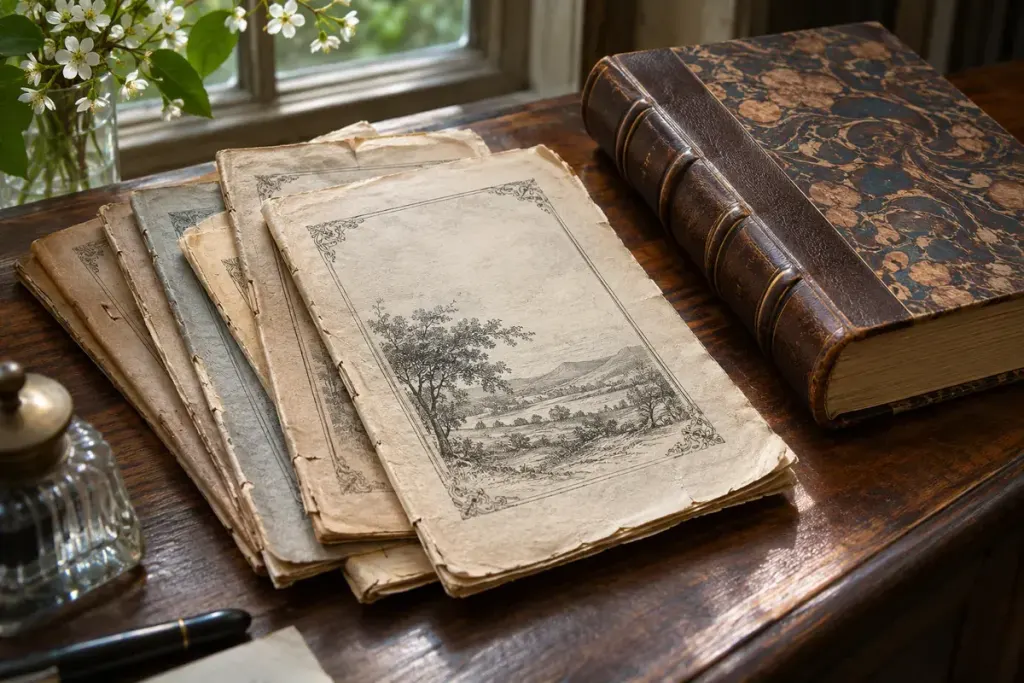
A novel on a shelf looks like one finished object. An original set of monthly parts tells a different story: separate paper wrappers, intervals between instalments, and material that readers encountered before reaching the fiction.
This is one reason a library display of apparently modest paper booklets can be as revealing as an elaborate binding. The wrappers are part of the publication’s history, not merely packaging waiting to be discarded.
Look at the pages around the story
Duke University Libraries’ Dickens exhibition explains how many of his novels first appeared in monthly parts and shows advertising from David Copperfield and Our Mutual Friend. The advertisements place the literary text within a commercial reading experience.
Smith College’s display of David Copperfield notes that wrappers and advertising were often discarded when parts were bound into a volume. A handsome later binding can therefore preserve the story while removing evidence of how it originally reached readers.
Neither format is inherently the only worthwhile object. They answer different questions. A bound copy may tell you about ownership and later use; parts may retain clues to the sequence of publication and the surrounding marketplace.
Try a slower comparison
When viewing digitised parts, choose a single instalment rather than racing through the whole novel. Note its opening, its closing, and any illustration or advertisement alongside it. Then compare that stopping point with the corresponding place in a modern edition.
What does the pause ask a reader to remember? Does an image establish an atmosphere before the prose does? What kinds of goods are advertised to the imagined buyer? These questions arise from the object itself; they do not require guessing how every Victorian reader felt.
For a physical collection, follow the library’s handling instructions and leave fragile wrappers and inserts in place. Do not remove advertisements to make a copy look tidier. Even a small printed slip can be evidence worth preserving, and a catalogue description may explain its significance better than the appearance of the main text alone.