
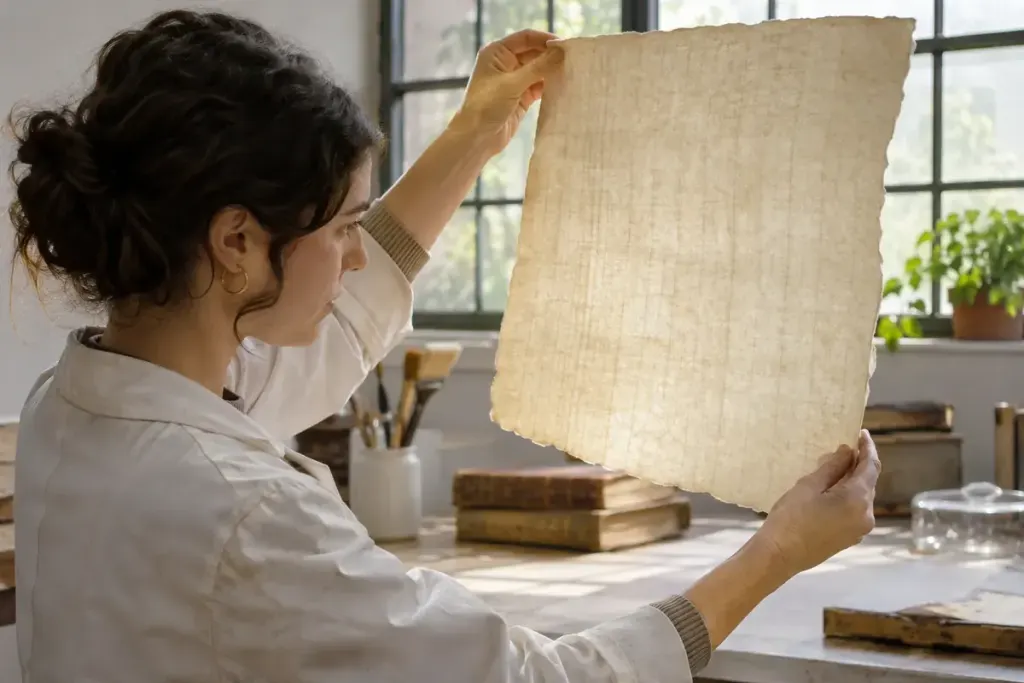
Hold a suitable sheet of old paper gently toward diffuse light and a faint grid may appear. Closely spaced lines run one way; more widely spaced lines cross them. These can be traces of the mould used to form the sheet.
The wider-spaced marks are known as chain lines, while the finer parallel marks are laid lines. The Folger Shakespeare Library’s introduction to reading old paper explains how such evidence helps book historians investigate a physical object.
Look without forcing the binding
Use an opening that the book supports comfortably. Do not flatten a tight binding or hold a fragile leaf by one corner just to make the lines easier to see. A conservator or reading-room staff member can advise on handling valuable or vulnerable material.
Note the direction of the visible lines relative to the page, any watermark, and whether neighbouring leaves appear similar. A simple sketch can be more useful than a photograph taken with harsh light. Record which leaf you examined so you can return to the same evidence later.
A clue is not a complete date
The arrangement of marks can help investigate paper manufacture and the way a sheet was folded into a book. It does not independently prove a publication year, identify an edition or establish authenticity. Paper can be stored before use, reused, or made to resemble an earlier style.
Imagine two copies with the same printed title page but different paper evidence. That is a reason to investigate their printing, binding and provenance, not an immediate verdict that one is a fake.
Combine the paper observation with bibliographic descriptions, signatures, watermarks and other physical details. The pleasure of chain lines is that they make manufacture visible; their research value comes from fitting that small observation into a larger, documented comparison.