
A closed book can show a plain gilded edge and still contain a painting hidden across its leaves. In a particular form of fore-edge painting, the image appears when the pages are carefully fanned into the position used by the artist.
The Boston Public Library’s fore-edge painting collection on Digital Commonwealth explains this effect and describes double paintings revealed by fanning in opposite directions. Its digitised collection offers a way to examine examples without handling fragile books yourself.
Look at the object record as well as the picture
When browsing, separate the book’s publication information from the description and dating of its decoration. Do not assume that a painting was made when the text was printed. A book can acquire binding, decoration, and ownership marks at different times.
For an original viewing exercise, choose one digitised example and write three notes: what the scene depicts, where the image sits on the object, and what the catalogue actually says about its date or maker. Leave an unanswered field blank rather than filling it with a plausible story.
Then compare the pictured scene with the book’s title. A relationship may be evident, but a landscape or building should not automatically be treated as an illustration of the text. The catalogue and any supporting research should determine what connection can be claimed.
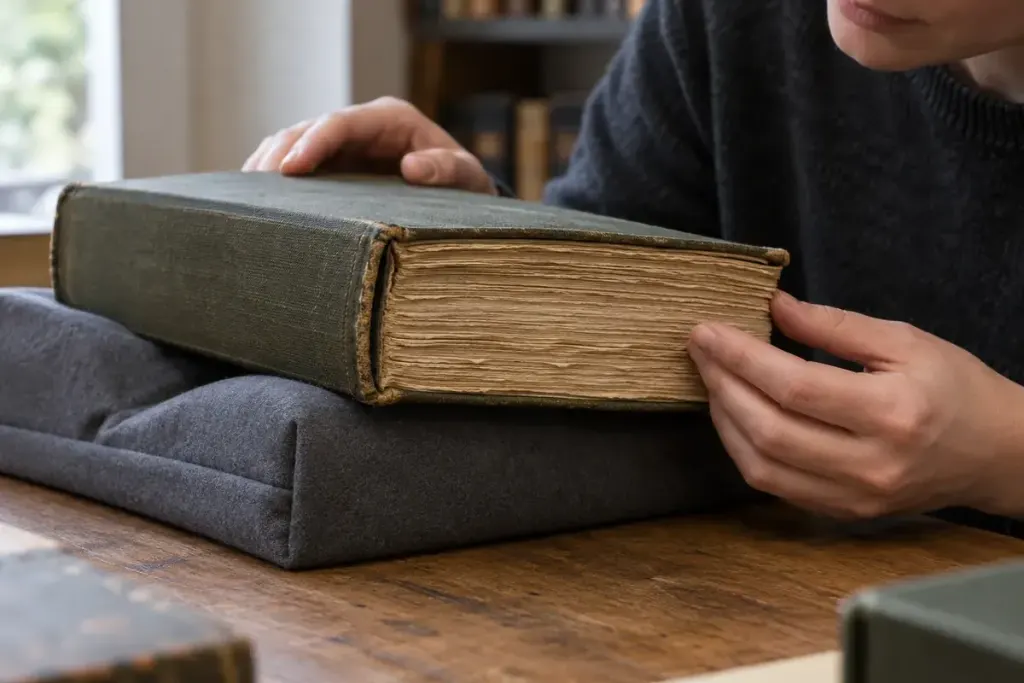
Do not force a valuable or unfamiliar volume open to search for a hidden image. Ask a librarian or conservator about safe handling and available photographs. The generated photograph accompanying this article is an illustration of examining a book, not documentation of a collection item.
Fore-edge painting rewards attention to the book as an object. The surprise is visual, but the useful research habit is careful: distinguish what the image shows from what the collection record can establish.