
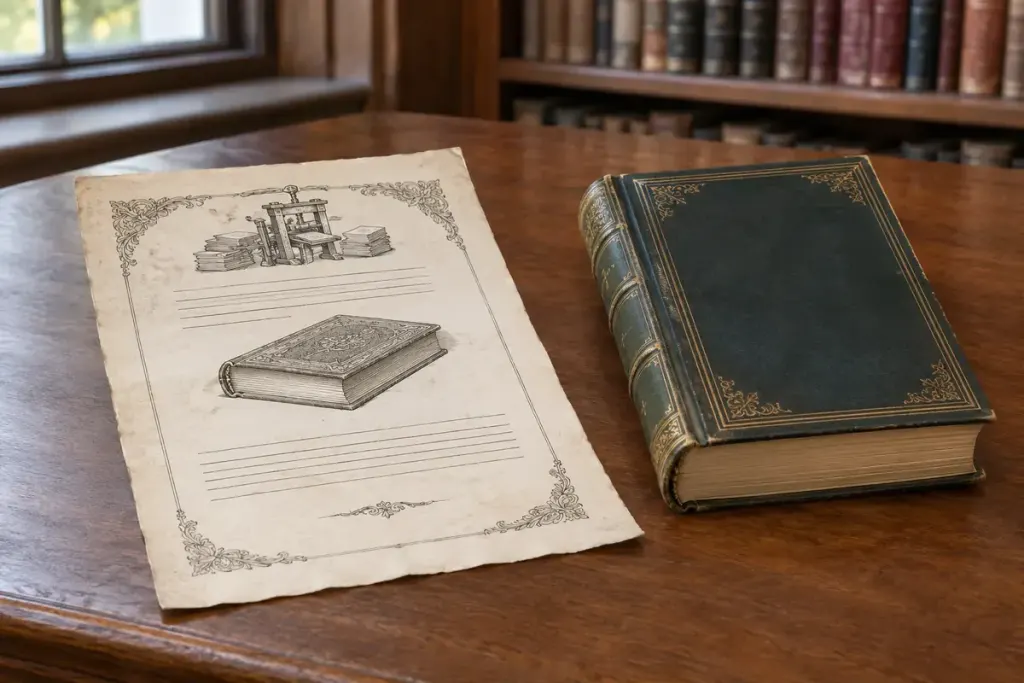
A thin printed leaflet tucked into an old book can preserve a moment when that book was still a proposal. A prospectus invited readers to support or reserve a forthcoming work, sometimes describing a publication that later changed shape.
The Folger Shakespeare Library’s guide to prospectuses distinguishes these notices from advertisements for works already published. Prospectuses may survive separately or bound into other material, which makes them easy to overlook if you examine only the main title page.
Read the promise as a promise
Look for the proposed title, author, format, illustrations, price and publication schedule. Note whether the leaflet offers subscriptions, reservations or an order form. Those details describe what the publisher was offering at that point; they do not prove that every feature appeared in the finished book.
Imagine a fictional prospectus promising twelve monthly parts with engraved plates. A later bound volume might contain a different number of parts or an altered plate list. The discrepancy is a research question. It is not automatically evidence that the copy on your table is incomplete.
Compare records without erasing uncertainty
Record the prospectus’s own date if present, and distinguish it from a date supplied by a catalogue. Copy the title as printed before adding your modern shorthand. If it is bound into a volume, note where it sits and whether the binding offers any clues about how the materials came together.
Use a library catalogue to look for the published edition and related prospectuses. The Folger guide also points out that not every piece of ephemera has a fully searchable online record. A failed keyword search is therefore not proof that no other copy survives.
For a personal collection note, keep two headings: “promised in prospectus” and “observed in this copy”. This simple separation prevents an attractive sales description from silently becoming a statement about the object you own.
The leaflet’s value as evidence lies in that earlier viewpoint. It lets you see a book being proposed to readers, before the finished volume could speak for itself.