
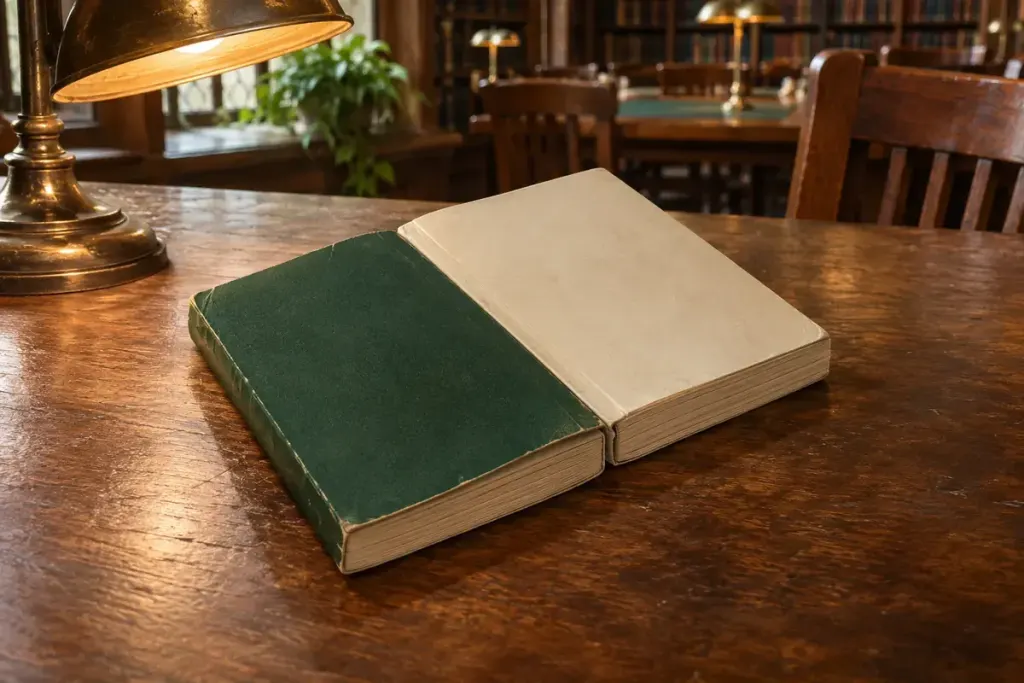
You reach the end of one text and discover another upside down. Turn the volume over, rotate it, and a second front cover becomes the beginning. A tête-bêche arrangement makes that reversal part of the book’s design.
The University of Utah’s artists’ book terminology guide describes two books oriented 180 degrees relative to one another. The Independent Online Booksellers Association explains the common-spine arrangement and provides an example with opposed covers and contents pages.
Check the structure before calling it a mistake
Look for a second title page, a deliberate cover design and a separate beginning to the page sequence. These clues can distinguish an intentional paired edition from a printing or binding error. Do not force the middle open to investigate; support the book as you would any binding.
The arrangement can invite the reader to compare two works, two voices or two directions of travel through an object. That effect depends on the particular publication. The binding does not tell you which work must be read first, or prove that the two texts are translations of one another.
Give both beginnings a place in your notes
When recording a reading edition, note both titles and authors where applicable, the publisher and date, and the physical arrangement. If each text starts its own pagination, include the relevant title when citing a page. “Page 12” alone may point to two different places.
A shelf photograph can also mislead if it shows only one cover. When buying a used copy, ask for the other cover and both title pages if the pairing is important to you. Check the seller’s description against what is visible rather than assuming every two-work volume uses this structure.
Related binding terms are sometimes used inconsistently, so a plain description helps: two works, inverted relative to each other, beginning from opposite ends of a common volume. That description preserves what makes the object interesting even when a catalogue’s terminology is brief.