
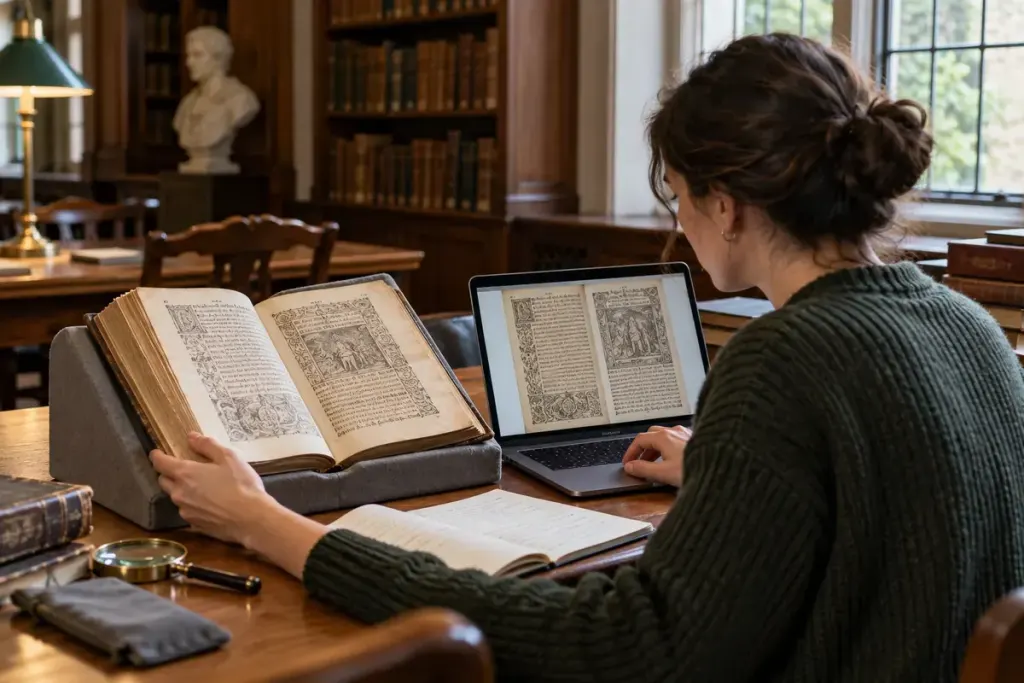
You open a digital facsimile of an old book and find two page numbers: one printed on the photographed leaf, another supplied by the viewer. Neither is necessarily wrong. They identify different things, and choosing only one can make a passage difficult to find again.
A facsimile reproduces the appearance of a source rather than simply presenting its words in a fresh setting. For example, Internet Shakespeare Editions’ facsimile collection organises early books by edition and identifies available copies. That makes the object behind the image part of the reading experience.
Identify the copy before the passage
Record the work, edition, date and holding institution where the collection supplies them. Two copies of the same printed edition may have different marks, missing leaves or binding histories. A handwritten note visible in one scan should not automatically be attributed to the author or to every copy of the book.
Keep the stable record link as well as your location within the viewer. In your working notes, distinguish the printed page number from the image sequence: for example, “printed page 24; viewer image 39.” Those are illustrative numbers, not a reference to a particular book.
Look at the page before reading through it
Notice the arrangement of headings, margins, columns and blank space. Ask what these features make easy or difficult to follow. Compare a short passage with a modern reading edition, but check whether spelling, punctuation or editorial additions have changed before treating the versions as interchangeable.
An unclear letter can remain unclear in your notes. Mark uncertainty instead of silently supplying the word you expect. If you use a transcription to help, identify that source separately; it represents another reading of the page.
Finally, distinguish seeing an image from handling the original volume. A screen can reveal valuable visual details, but it cannot establish paper feel, binding behaviour or every physical feature. A careful note says what you examined and leaves the absent evidence absent.