
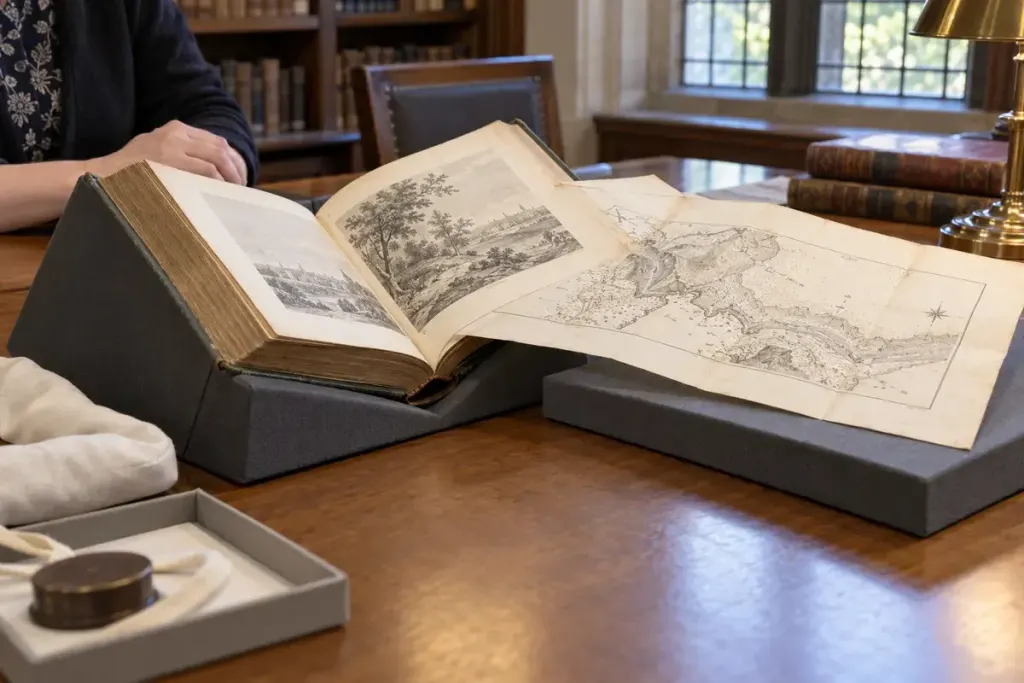
A map tucked into a book can be much wider than the volume holding it. When opened without preparation, its outer section may hang over the table while the narrow join to the book carries the strain. Make space for the sheet before unfolding it.
Support the book and the extension separately
The Warburg Institute’s handling guidance recommends suitable book supports, opening one fold-out at a time and treating the join carefully. The book itself should not be forced flat just because the extra sheet needs a wider surface.
In a library or archive, ask staff to arrange the appropriate supports. Move your notebook and other belongings out of the opening area first. Keep food and drinks away, and do not place a personal object on the sheet to make it stay down.
Open the folds slowly in their existing direction, supporting the moving section. If a fold resists, a tear is visible or the paper feels brittle, stop. A reading-room assistant or conservator can decide how it should be consulted; ordinary adhesive tape is not a reader’s repair tool.
Read without repeatedly reopening
Once safely supported, identify the information you need. A note of the plate title, location in the book and the area examined may save unnecessary handling later. If photography is permitted, follow the collection’s rules and keep equipment from touching the item.
Cambridge University Library’s special-collections guidance likewise calls for extra support for fold-outs and advises readers to ask staff when handling is uncertain. A striking illustration is not a reason to make a fragile binding open farther than it comfortably allows.
Before closing, reverse the fold sequence carefully and check that no edge protrudes into a place where the cover will trap it. Do not compress an incorrectly folded sheet to make the book shut.
The successful reading session is one in which both the information and the object remain available for the next reader. A little preparation around the book makes that much easier than trying to catch a sagging sheet halfway through unfolding it.