
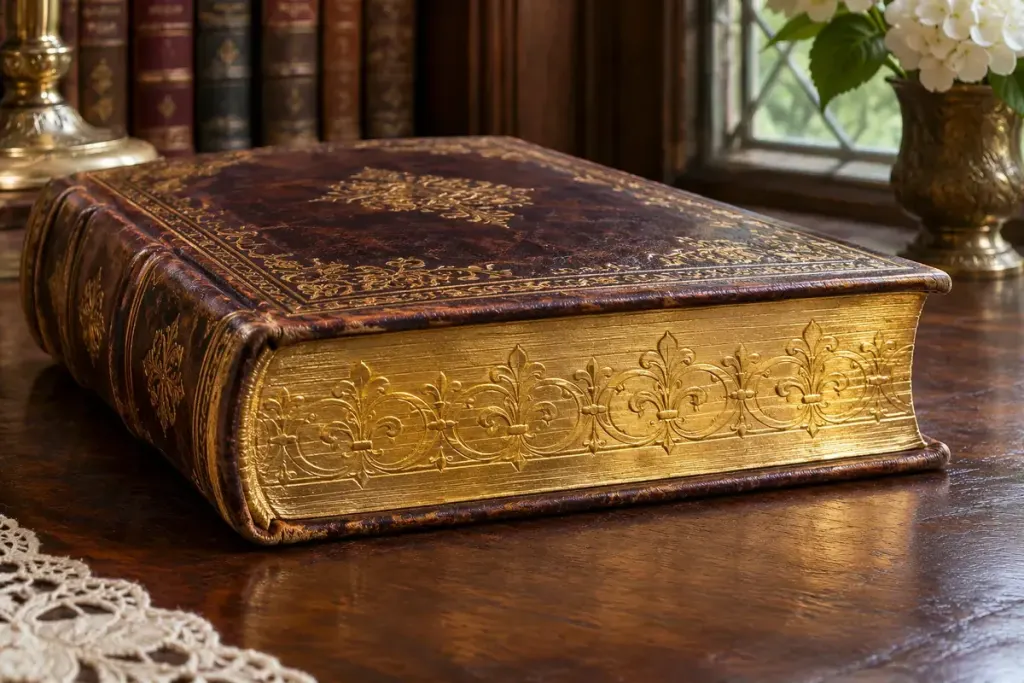
Close an elaborately bound book and the page edges may reveal a second decorative surface. Small repeated dots, flowers or geometric impressions can sit within the gilding, catching the light differently as the book is turned.
This is often described as gauffering. The Etherington and Roberts bookbinding dictionary explains that heated finishing tools or rolls impress patterns into book edges, usually after gilding. The decoration is therefore part of the physical surface, rather than simply a picture printed on the outside pages.
Look with light, not with a fingernail
Support the closed book and use ordinary light from a shallow angle. Notice whether the pattern repeats across the fore-edge, top and bottom, or appears only in selected areas. Do not scrape the gilding to test whether an impression is real.
A useful catalogue note separates the observed features: gilt edges, a repeated point pattern, traces of colour, and any areas of loss. Describe what you can see before deciding when or where it was made. A decorative technique can persist or be revived, so it cannot date a binding on its own.
Compare the edge treatment with the boards and spine. Does the same motif recur? Are all three edges equally decorated? These questions help you understand the book as an object, without assuming that every part was produced at the same moment.
Keep technique and condition apart
An intentional impression can look like a dent in a poor photograph. Conversely, damaged gilding should not automatically be described as decorative tooling. When buying remotely, ask for clear photographs of the relevant edges and an honest condition description.
For an old or valuable book, avoid home polishing or attempts to brighten the gold. Record the appearance and seek conservation advice when needed. The pleasure of finding gauffering is that a part of the book usually seen only on the shelf becomes worth studying in its own right.