
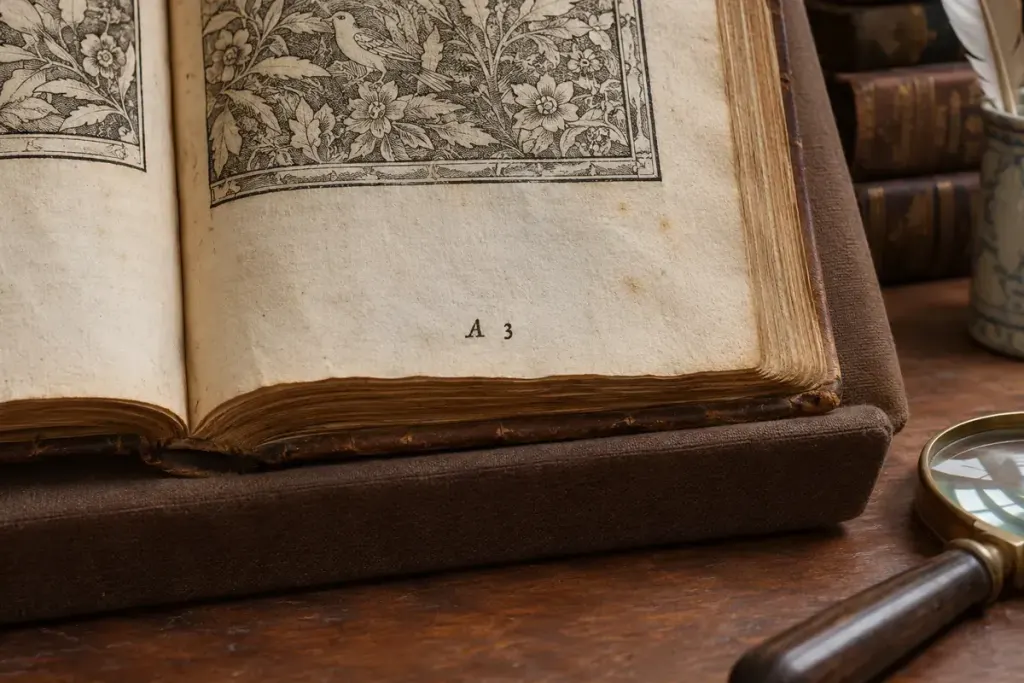
At the bottom of an old printed page, a small “B2” sits apart from the text. It may look like a stray reference or an owner’s code. In many handpress books, such a mark helped identify a leaf within a gathering so that the printed sheets could be assembled correctly.
The Folger Shakespeare Library’s explanation of signature marks distinguishes the gathering letter from the leaf number. This use of “signature” belongs to book construction; it does not mean the author has signed the copy.
Look at the surrounding leaves
Do not interpret one mark in isolation. Check where it appears, whether it is printed in the same ink and how nearby leaves are marked. A sequence may help explain the structure, but missing or inconsistent marks need care. Not every leaf has to carry a printed signature mark, and an error in a mark does not automatically mean the book is wrongly bound.
Keep pagination separate in your notes. A page number counts pages; a signature reference identifies a position in the gathering structure. The two systems can coexist. If a catalogue or scholarly reference uses a recto or verso suffix, establish which side of the leaf is meant before quoting the passage.
A useful observation record
For a personal study, record the book’s edition details, the visible mark, its location and a photograph permitted by the library or owner. Add a question rather than an unsupported conclusion: “Mark appears as B2; following leaf unmarked; compare catalogue collation.” That gives a librarian or bibliographer something concrete to examine.
Handle the book on an appropriate support and do not force the binding open to inspect the inner fold. Online facsimiles can help you follow a sequence without repeatedly stressing the physical copy.
Signature marks reward patient comparison. They can make the manufacturing history of a book visible, but they are one piece of evidence among paper, printing, binding and the edition’s documented collation.