
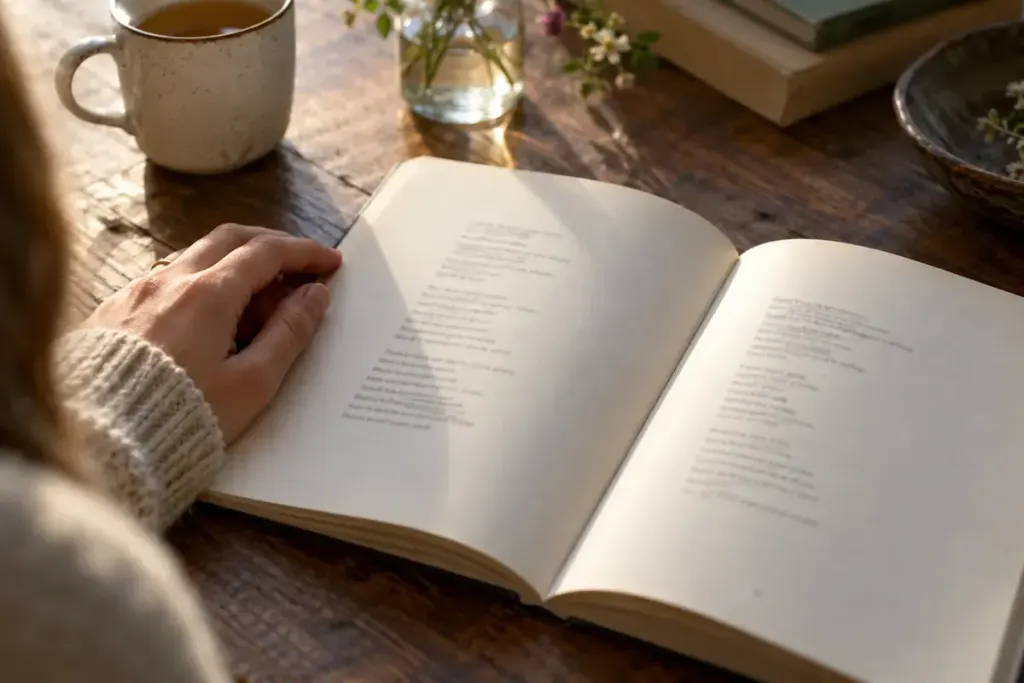
A verse novel can move through a story quickly while asking the eye to slow down on a single page. Its short lines do more than reduce the amount of print. They can shape emphasis, pace and the moment when a thought becomes complete.
Follow both the sentence and the line
Read a short passage silently, noticing where each line ends. Then trace the sentence through the punctuation. Sometimes the line and sentence finish together; sometimes the thought carries across the break. Neither pattern requires you to impose an identical pause at every line ending.
For an invented example, compare “She left the key / beneath the cup” with the same words on one line. The break briefly holds back the location. That observation concerns this arrangement, not a universal meaning for every broken line.
Give white space a question
When a page leaves a large gap, ask what changes across it: time, speaker, setting, emotional distance or the rhythm of the reading. Keep the answer provisional until the surrounding text supports it. A visual feature can invite attention without supplying one fixed interpretation.
Read a passage aloud if that helps, but try more than one phrasing. Your spoken version is an interpretation too. Compare it with the printed punctuation and the narrative context rather than deciding the first reading must be correct.
- Mark a line ending that changes your expectation.
- Notice repeated shapes or lengths across several pages.
- Track the speaker separately from the visual layout.
- Record a short observation without copying whole pages.
A plot summary can miss these effects because it rearranges the words into ordinary prose. When discussing the book, include one specific description of how the page shaped your attention.
You do not need specialist terminology to begin. “The next line made me revise the first impression” is already a useful reading note, provided you can point to what the text actually does.