
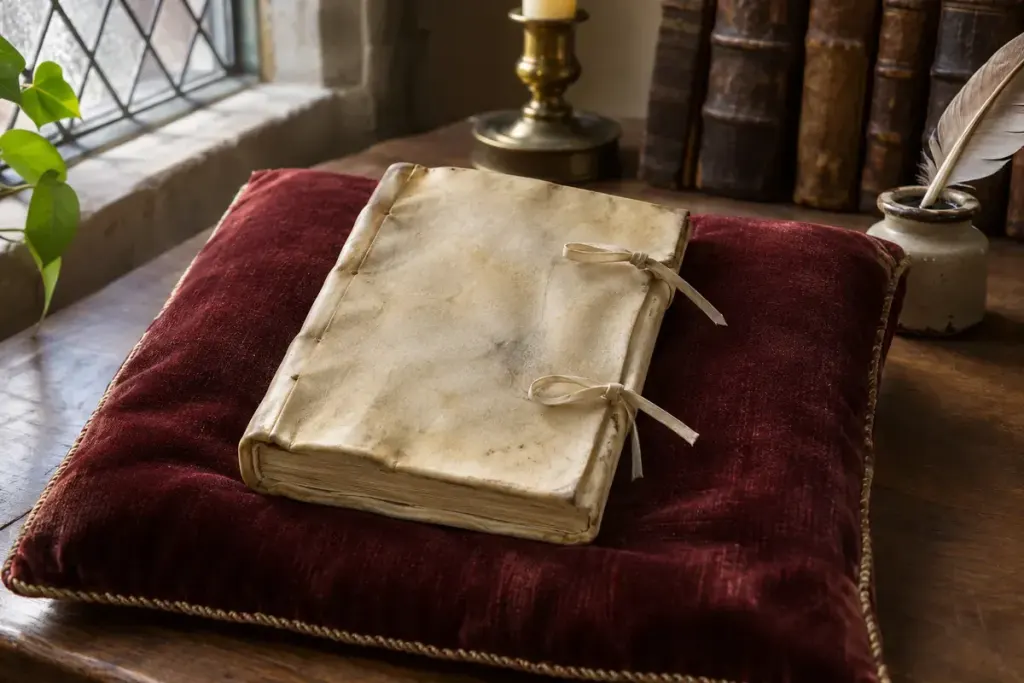
A book cover need not contain rigid boards to protect a text block. In a limp vellum binding, the parchment cover itself provides a flexible enclosure. The resulting object can feel quite different from the stiff case many readers expect when they hear “hardback”.
A Cambridge manuscript catalogue entry for Queens’ College MS 33 records a limp vellum binding with details of its construction. Such entries are useful because they describe an individual object rather than reducing every flexible parchment binding to one timeless recipe.
Read the description in parts
“Limp” concerns the cover’s flexibility. “Vellum” identifies the material terminology used by the catalogue. Other words may describe ties, turn-ins, sewing or attachments. Do not assume that one term supplies all of those details.
When comparing catalogue photographs, look at the fore-edge, the spine and any visible fastening. Note what can actually be seen and what comes only from the written description. A closed frontal photograph may reveal very little about how the text block connects to its cover.
The binding has its own history
A manuscript’s text and its present binding need not be the same age. Rebinding, repair and conservation can add later layers to an older object. If a sale listing offers a date, ask whether it refers to the writing, printing, binding or another feature.
For your own collecting notes, separate three fields: the catalogue’s stated date, its binding description and any uncertainty it acknowledges. This avoids turning an attractive old-looking cover into evidence for a date it cannot establish.
Handle historical books according to the holding institution’s instructions. Flexibility is not permission to bend a cover back, flatten a page or test the strength of a tie.
The pleasure of recognising a limp vellum binding lies in seeing another solution to the ordinary problem of holding pages together. Its flexible exterior is a starting point for examining the object, not the whole story of its manufacture.