
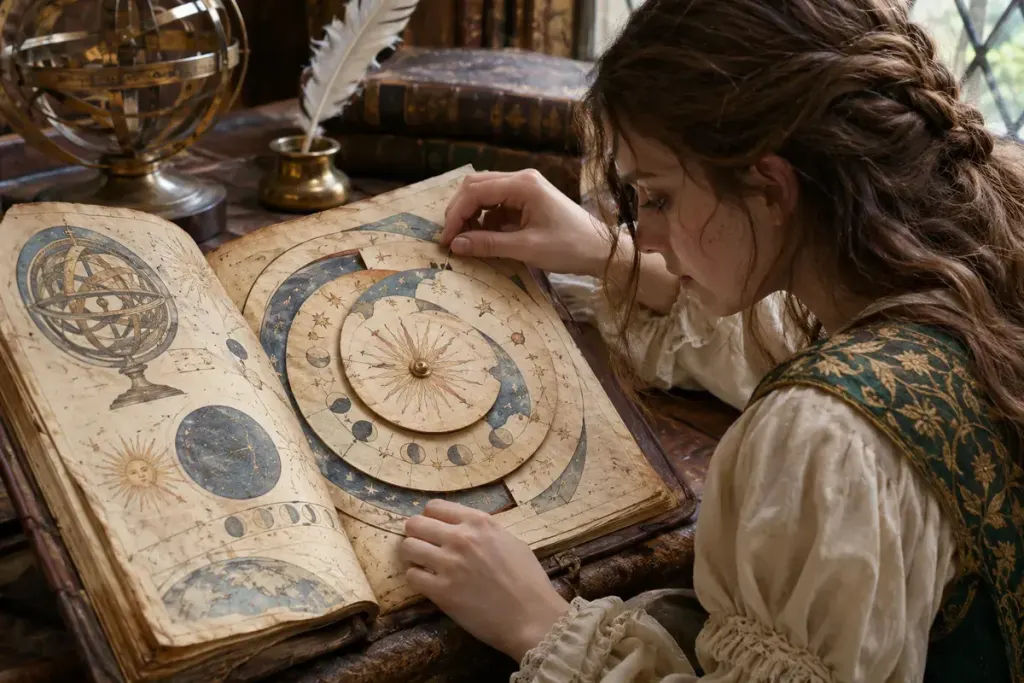
Some books ask the reader to turn more than a page. A volvelle places one or more rotating discs on the page itself, allowing an illustration, scale or pointer to move against another part of the design. The book becomes something the reader operates.
The Smithsonian Libraries’ introduction to volvelles places these paper mechanisms within a history extending more than eight centuries. They belong to the wider family of movable books, alongside flaps and pull tabs, but rotation gives them a particularly useful way to show changing relationships.
Look for what stays still
Before trying to interpret a wheel, identify its fixed background. Then find the moving disc, any pointer and the point around which the assembly turns. Words on the surrounding page may tell the reader which mark to align first.
A university collection offers a revealing example: the University of Auckland’s account of revolving diagrams describes layered astronomical illustrations, including a surviving fragment of a pointer. An incomplete mechanism can therefore retain much of its picture while losing something essential to its operation.
Read a scan as one position, not every position
A digitised page freezes the wheel wherever it happened to be when photographed. A label hidden beneath a disc may still be present in the original. Conversely, an apparent blank may reflect a missing piece rather than a deliberately empty design.
For your reading notes, separate three observations: what is visible, what the instructions say should move, and what the scan cannot establish. This avoids turning a guess about the mechanism into a description of the physical copy.
Try the principle with an ordinary paper model
On scrap card, draw a ring of four seasons and place a smaller disc with a single window over it. Rotate the window to reveal each season. This simple exercise does not reproduce a historical instrument; it helps explain why a book designer might make relationships visible through movement.
Do not test an old book’s wheels by forcing them. Ask the holding library about handling or request additional photographs. The interesting question is not simply whether the paper still turns, but what turning it once allowed a reader to understand.