
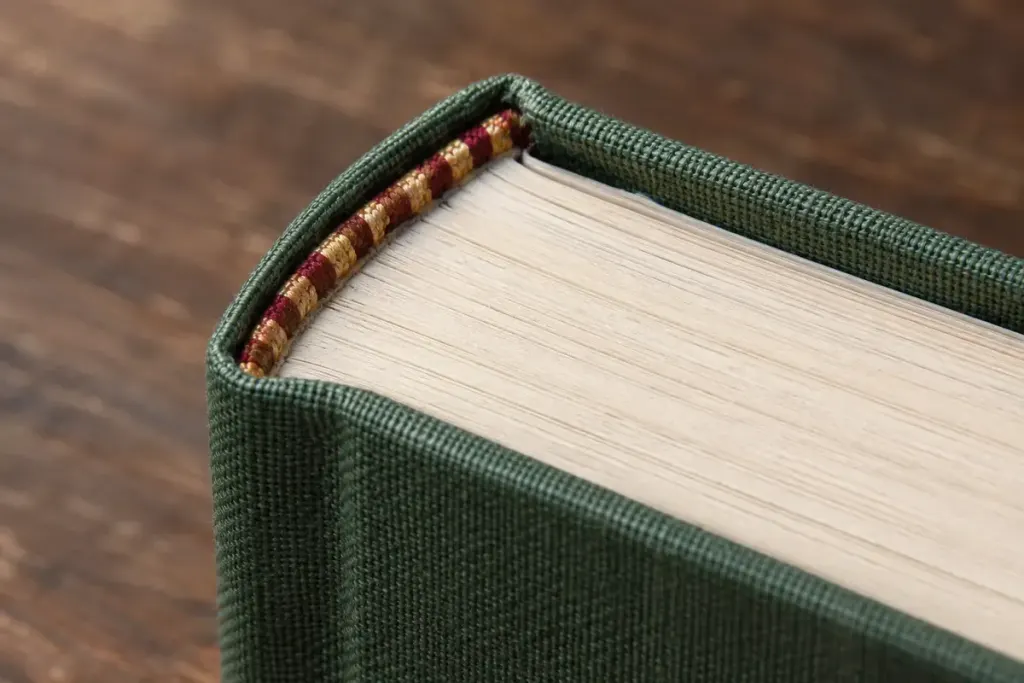
Look down at the top of a hardback near its spine. Between the pages and the covering, you may see a narrow band of coloured thread. It is a small detail, but it invites a surprisingly large assumption: does that visible stitching mean the book was sewn by hand?
Not necessarily. An endband can be worked as part of a binding, or supplied as a separate strip that is attached during finishing. The appearance at the edge does not reveal the whole construction.
Two ways to arrive at a similar detail
In an account of an Islamic binding workshop at Duke University Libraries, conservators describe making woven silk endbands as part of the binding work. It is a useful example of the craft involved in a sewn structure.
At the other end of the production process, bookbinding supplier Richter & Menzel describes a ready-made fabric headband glued at the top and bottom of a book’s spine. A tidy decorative strip can give a finished edge without telling you how the page gatherings themselves are held together.
Use it as a question, not a verdict
If you are comparing editions, ask the publisher or binder about the page binding directly. Is the text block sewn in sections? What covering material is used? Can the book open comfortably for the reading you intend? A photograph of the little coloured band answers none of those questions by itself.
You can make a simple shelf observation without stressing the books. Compare a modern hardback with a known handmade binding, keeping both supported. Note the band’s width, colours and how it meets the spine. Describe what you can see; leave the hidden attachment as unknown unless the maker has documented it.
Do not pull the band to test whether it is structural. If it is loose on a valued book, keep detached material and ask a book conservator about the whole binding before adding glue. The attractive detail deserves attention, but it should not become a handle or a home-made strength test.