
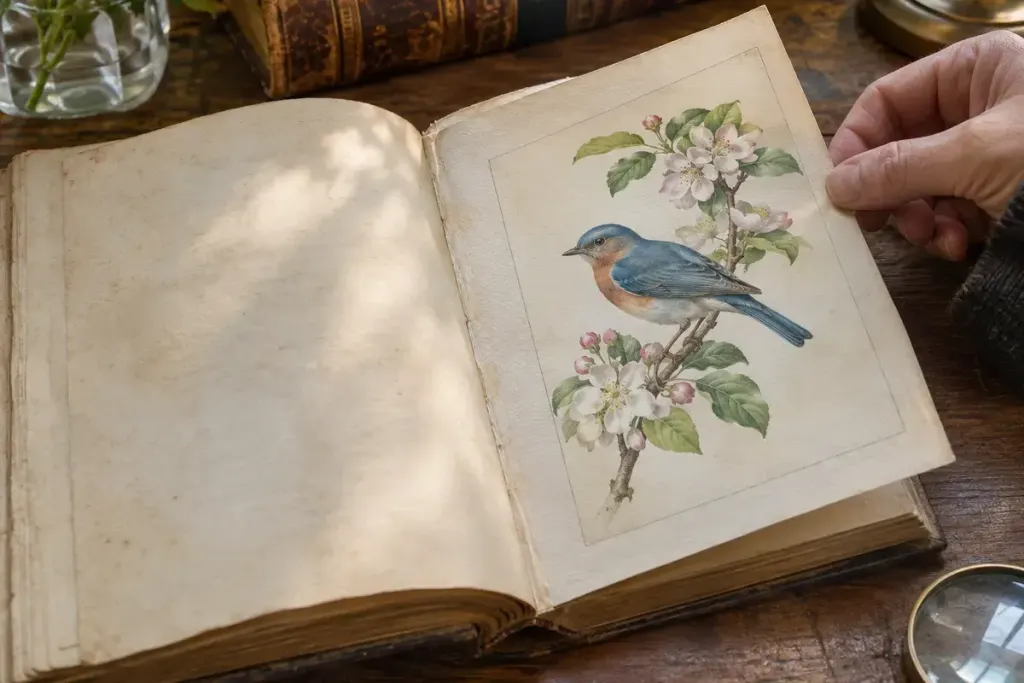
An illustrated leaf can belong to a book without being sewn into one of its folded gatherings. When a leaf is tipped in, an edge is attached with adhesive. The difference may be subtle until you look at the inner margin.
The University of Missouri’s rare-book glossary defines tipping in as gluing a leaf into a book along an edge. Plates printed separately from the main text are one place a reader may encounter this construction, although an attached leaf can serve other purposes too.
Notice the join without testing it
Support the open book and let the page turn at its natural hinge. A narrow attached edge may be visible near the gutter. Do not tug on the leaf to establish how firmly it is held, and do not force the book flat to make the join easier to photograph.
A tipped-in plate is different from an illustration laid loosely between pages. Neither construction alone proves that the book is complete, original or valuable. An inserted item may be original to an edition, added later, or part of a documented repair; the surrounding evidence matters.
When comparing a book with a catalogue description, record the location of the plate and any caption, tissue guard or relevant page reference. A photograph of the whole opening is often more informative than a cropped image of the illustration alone. Check an authoritative collation or institutional copy when completeness is important.
Describe condition precisely
If the attachment has partly released, say so. Describing a plate as present but partly detached is more useful than calling the book fine because the image is still inside it. Avoid adding household adhesive or tape: an unsuitable repair can stain the paper and complicate later conservation.
The small join tells a story about how the book was assembled. Reading that construction carefully adds information while leaving the physical evidence intact for the next reader.