
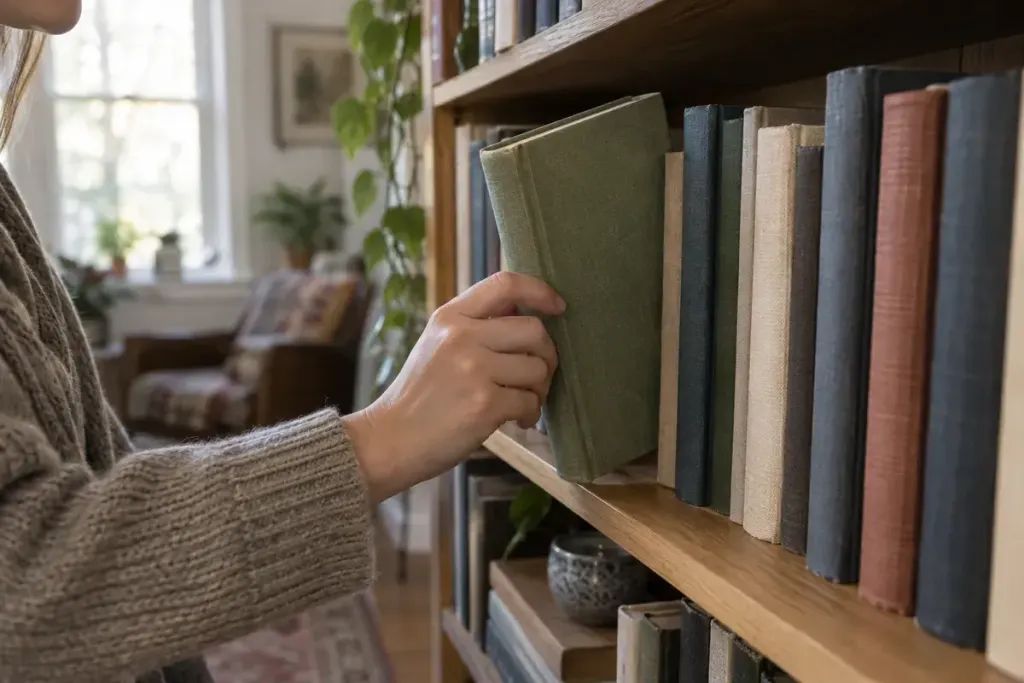
The new book fits—just—if you push the neighbouring volumes tightly enough. It is an easy habit to develop, especially on a shelf arranged to look complete. But a collection that is difficult to remove and replace is also difficult to use gently.
Start with one shelf rather than dismantling the whole room. Give yourself a clean, dry surface nearby and decide where books can rest safely while you work. Keep the task small enough that you can finish it without leaving unstable piles around the house.
Look at access before appearance
Notice which books require force to remove, which lean heavily and which are too large for their position. You are looking for practical problems, not judging whether the collection looks sufficiently organised.
The Canadian Conservation Institute’s basic book-care guidance advises against overcrowding shelves and describes supporting books appropriately. It also recommends easing a book out by its middle rather than pulling at the top of the spine. Use both hands for a large or heavy volume.
Create space without making another awkward stack
Move a manageable group to the prepared surface and consider whether some belong elsewhere. Frequently used books should be easy to reach. Oversized or fragile items may need a different arrangement from ordinary paperbacks; seek appropriate preservation guidance for the materials and condition involved.
A temporary sorting note can help: keep here, move to another suitable shelf, or assess separately. Avoid placing a damaged volume back under pressure simply because deciding what to do with it feels inconvenient.
Check the place where the shelf lives
Look for direct sunlight, signs of damp, nearby leaks or a position where books are regularly knocked. The Library of Congress’s preservation guide emphasises prevention through storage, environment and handling. A tidy arrangement cannot compensate for a location that repeatedly exposes books to harmful conditions.
You do not need to turn a home into an institutional archive to notice a window leak or a bookcase beside a source of heat. Begin with the obvious practical issue and get qualified advice where a valuable or vulnerable collection requires more specialised care.
Keep rearranging separate from repairing
If a cover is loose or pages appear fragile, resist the urge to fix it with whatever tape or glue is nearby. Ordinary household repair materials can complicate later treatment. For significant damage, consult a book or paper conservator about suitable options.
Do not brush away suspected mould as part of a casual tidy-up. Stop and seek professional guidance on safe handling and the conditions that caused it. The aim of this shelf exercise is better access, not an improvised conservation treatment.
Test the finished shelf with one ordinary action
Take a book out and return it gently. Can you do that without pulling at the top, scraping the cover or forcing its neighbours aside? Is the remaining row supported? That simple test is more informative than whether the spines form a perfect visual line.
Leave a little capacity for change and review the shelf when new books arrive. A good home library is a place where books can be read and returned comfortably, not a puzzle that becomes harder to solve with every addition.