
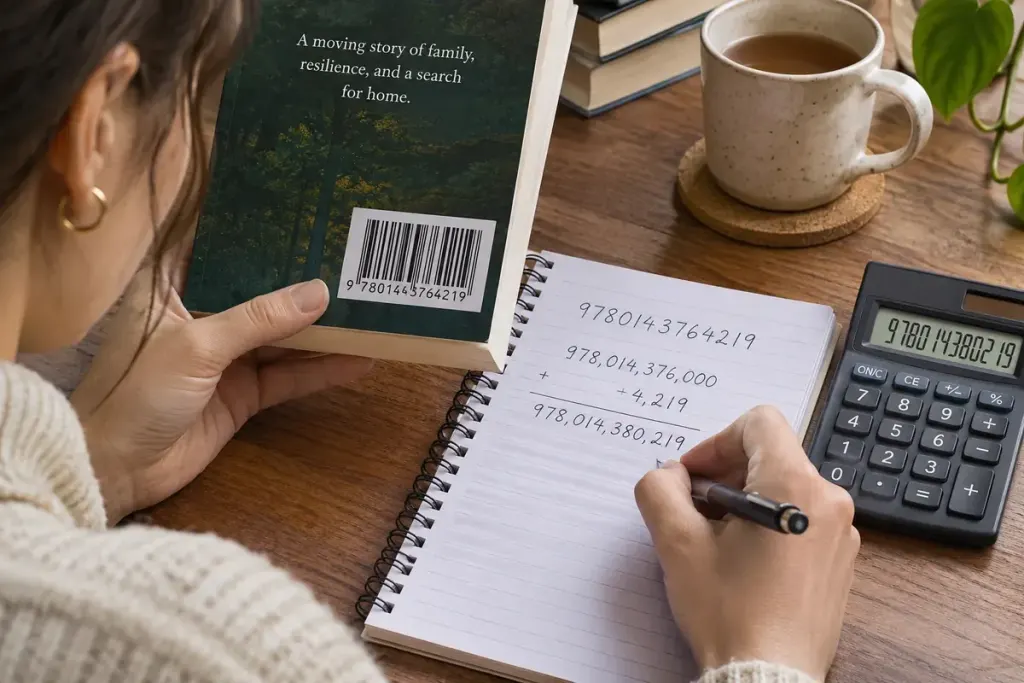
Mistyping one digit can send a book search in the wrong direction. An ISBN-13 includes a small safeguard: its final digit is calculated from the twelve before it. A checksum can catch many copying mistakes before you blame a catalogue.
The International ISBN Agency’s manual explains the alternating weights used in the calculation. Ignore spaces and hyphens, then multiply the first twelve digits alternately by 1 and 3. The check digit makes the final weighted total a multiple of ten.
A deliberately small worked example
Use the illustrative twelve-digit sequence 978000000000. This example demonstrates arithmetic; it is not a claim that the resulting identifier has been assigned to a book.
- The first three contributions are 9 × 1, 7 × 3 and 8 × 1.
- The remaining nine digits contribute zero.
- The sum is 38, so a final digit of 2 brings the total to 40.
Now imagine typing the last of those twelve digits as 1 instead of 0. That position carries a weight of 3, making the sum 41. Keeping the old check digit of 2 would produce 43, so the checksum fails.
What passing the check does not prove
A mathematically valid sequence is not proof of an assigned ISBN, an available book or the edition you want. Some multiple-digit errors can also leave a checksum valid. Always compare the title, author, publisher, format and edition information with a trustworthy catalogue or the book itself.
Older ISBN-10 identifiers use a different calculation and can end in X. Do not apply the thirteen-digit method to ten digits and interpret the failure as evidence that the book is suspicious.
When checking a second-hand listing, ask for a photograph of the identifier if the typed number fails. That is often more useful than repeatedly searching a faulty string. Use the checksum as an early error check, then use bibliographic details to decide whether you have found the right book.