
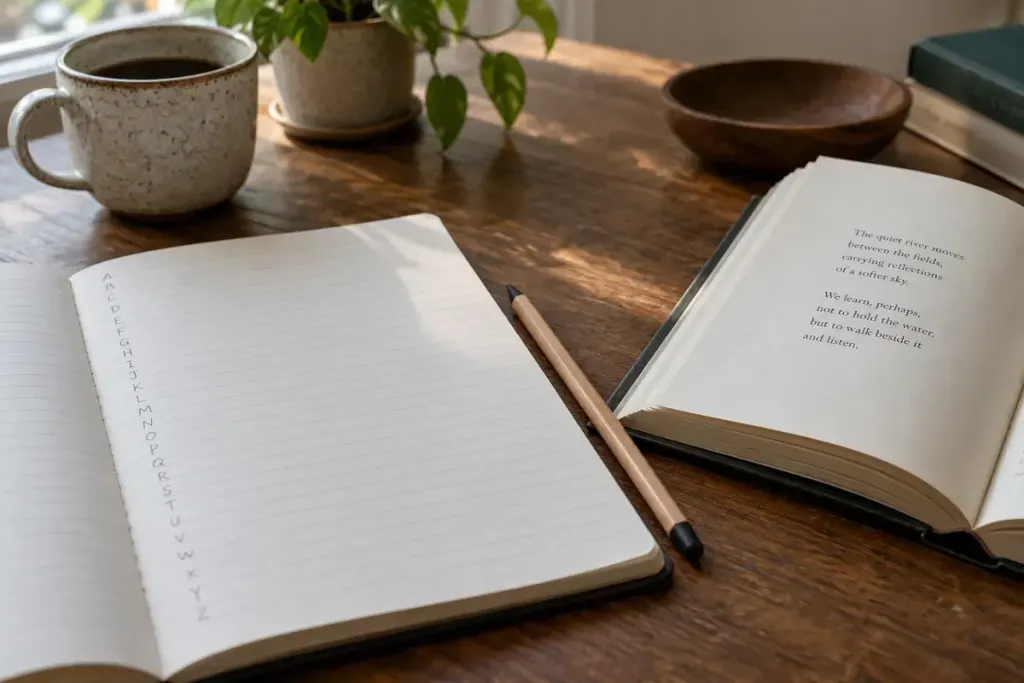
A poem can begin with a rule as modest as “the next line starts with the next letter”. The alphabet supplies an order, while the writer discovers what can happen inside it.
The Academy of American Poets’ definition of the abecedarian describes a form generally organised by successive letters at the beginning of lines or stanzas. Its long history reaches beyond children’s alphabet games. The constraint can guide serious, playful or uneasy writing without deciding the subject in advance.
Try four letters before attempting the whole alphabet
Here is a small original practice fragment:
After the rain, the gate swings wide.
Behind it, a bicycle waits.
Clouds leave their shapes in the puddle.
Down the lane, someone calls us home.
The first letters establish A, B, C and D. The lines still describe a connected scene. That connection matters: a list of unrelated objects can satisfy the alphabet rule while offering little reason to keep reading.
Choose a place you can picture—a kitchen after dinner, a station platform or an empty classroom. Write four to six lines following consecutive letters. Keep a detail from one line alive in the next, even if the required initial sends you towards an unexpected word.
Then read the fragment without looking at the margin. Does it have movement or a change of attention? If the only interesting feature is the alphabet, revise the scene before extending the sequence.
When reading a published example, look at how the poet handles difficult transitions. An unusual opening word may create surprise, but it may also feel forced. Ask what the constraint adds to the voice rather than treating completion from A to Z as the whole achievement.
You can also compare this with an acrostic, where initial letters spell a chosen word or name. The organising pattern changes, and so does the pressure on the next line. Keep your experiment labelled as an exercise; a useful formal rule is a starting point for revision, not a certificate that the poem is finished.